
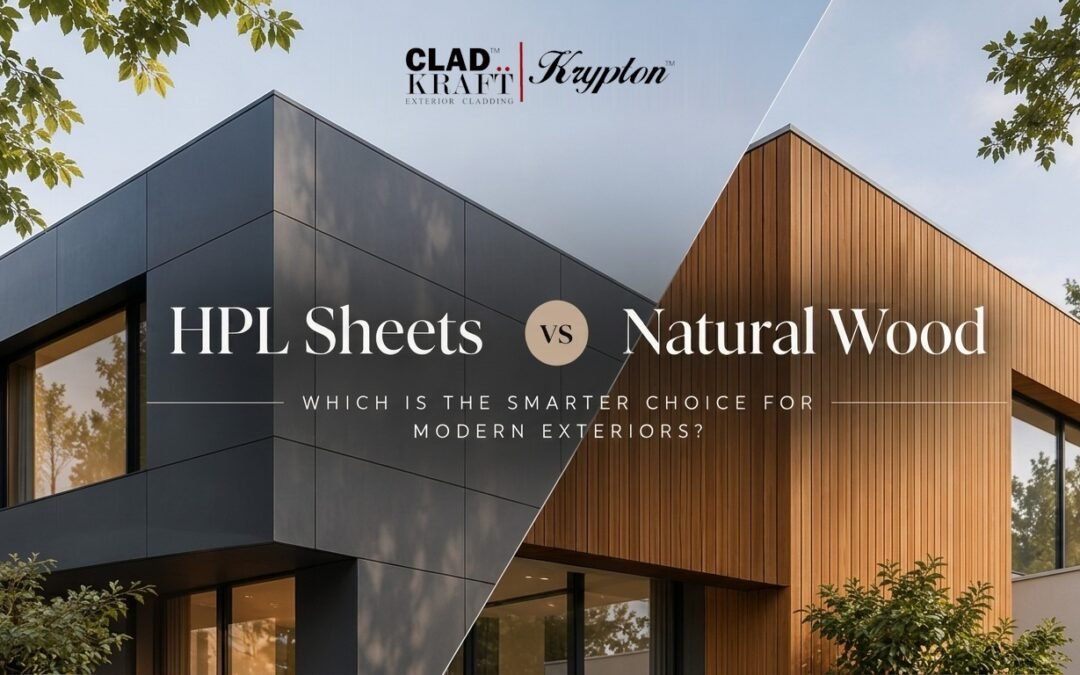
HPL Sheets vs Natural Wood for Exterior Applications: Performance Comparison
Last updated: November 2, 2026
When comparing HPL sheets vs natural wood for architectural facades, gates, and elevations, exterior High-Pressure Laminate (HPL) compact panels outperform natural timber in weather endurance, termite resistance, fire safety, and lifecycle maintenance. Natural wood offers unmatched authentic tactile warmth, but requires recurring sanding and oiling every 1 to 2 years. For exterior building facades, main gates, and balcony elevations exposed to heat and monsoon moisture, exterior HPL provides a more durable, low-upkeep alternative.
Key Takeaways
- Natural timber offers genuine grain variation, but expands, contracts, and degrades under severe tropical rain and UV exposure.
- Exterior HPL compact panels resist water absorption, UV fading, fungal rot, and termite attack without seasonal chemical sealing.
- Natural wood facades require recurring sanding, resealing, and protective oiling every 1 to 2 years to prevent weather-induced decay.
- Cladkraft Woodkraft exterior compact panels provide natural architectural timber textures backed by an official 10-year manufacturer warranty.
- Rear-ventilated rainscreen framing is necessary for exterior HPL to maintain air circulation and manage thermal expansion.
HPL Sheets vs Natural Wood at a Glance
The table below outlines the core technical, maintenance, and structural trade-offs in the HPL sheets vs natural wood performance comparison:
| Performance Factor | Natural Exterior Wood (Teak, Pine, Ipe) | Exterior HPL Compact Panels (e.g. Cladkraft Woodkraft) |
|---|---|---|
| Primary Material | Solid organic timber planks | Kraft paper and thermosetting phenolic resins with UV overlay |
| Surface Authenticity | 100 percent natural tactile grain and unique organic variation | Engineered woodgrain decors with consistent architectural finish |
| Weather Resistance | Moderate; susceptible to cupping, warping, surface graying, and cracking | High; non-porous surface resists rain, coastal humidity, and thermal cycling |
| Maintenance Routine | Sanding, staining, oiling, and sealing every 12 to 24 months | Occasional surface washing with clean water and mild soap |
| Termite and Pest Risk | High; requires ongoing chemical anti-termite treatments | Zero; synthetic phenolic resin matrix offers no organic food for pests |
| Fire Performance | Combustible unless heavily treated with fire-retardant chemicals | Excellent fire retardant; self-extinguishing core formulation |
| Structural Board Type | Solid wood planks fixed onto timber or metal battens | Self-supporting compact panels fixed onto aluminium or GI sub-frames |
| Warranty Coverage | Rarely warranted against exterior weathering by lumber yards | 10-year manufacturer warranty on structural integrity and finish |
| Best Architectural Uses | Sheltered outdoor ceilings, covered porticos, luxury low-rise accents | Building facades, residential main gates, balcony railings, duct louvers |
What is Natural Wood Cladding and Where Does It Excel?
Natural wood cladding consists of solid timber planks mounted horizontally or vertically to form an exterior facade or gate surface. Builders typically use hardwoods like Burma Teak, Ipe, Meranti, or treated softwoods like Thermowood and pressure-treated pine.
Real timber excels in authentic tactile appeal and traditional craftsmanship. Every plank contains natural rings, grain shifts, and organic depth that manufactured alternatives cannot duplicate completely up close. For luxury villas, sheltered entrance porticos, and low-exposure architectural accents, natural timber creates an organic connection between the building and its natural surroundings.
However, wood is an organic, porous material. It naturally absorbs atmospheric moisture during rainy periods and releases it during dry, hot weather. In regions with intense solar heat and heavy monsoons, this moisture movement causes timber to cup, crack, twist, and split. Left untreated, UV radiation strips the natural oils from the wood surface, turning rich brown timber into a weathered gray tone within months. Understanding these physical vulnerabilities is essential when weighing HPL sheets vs natural wood for exposed exterior elevations.
What are Exterior HPL Compact Panels and How Do They Work?
When examining HPL sheets vs natural wood for architectural applications, exterior High-Pressure Laminate compact panels represent dense, self-supporting boards engineered specifically for outdoor building envelopes. They are manufactured by fusing layers of cellulose kraft paper impregnated with thermosetting phenolic resins under high pressure (exceeding 7 MPa) and temperatures above 120 degrees Celsius, adhering to international EN 438 compact laminate standards.
The outer face features a decorative layer protected by a weather-resistant exterior film. This protective layer shields the board from ultraviolet radiation, preventing solar fading and color breakdown. Unlike standard 1mm interior decorative laminates that require a plywood or MDF core, exterior compact panels are dense, solid structural boards (typically 6mm, 8mm, or 10mm thick).
Architectural collections like Cladkraft Woodkraft recreate authentic timber aesthetics, including teak, walnut, oak, and weathered cedar patterns. The panels combine the visual warmth of natural architectural timber with the impact resistance and structural stability of high-density thermoset composites. Cladkraft positions this performance balance under the motto: “Looks like luxury. Works like concrete.”
Durability and Weather Resistance in Tropical Climates
A comparative evaluation of HPL sheets vs natural wood in tropical and coastal climates highlights significant performance differences. Exterior HPL panels hold a clear durability advantage over natural timber in tropical and coastal climates. In regions like Tamil Nadu and broader South India, exterior building materials endure intense summer heat up to 42 degrees Celsius, high humidity, and torrential monsoon downpours. Backed by Cladkraft Krypton’s Chennai manufacturing base, exterior compact panels are engineered to resist high thermal cycling and coastal moisture without delaminating.
Natural timber absorbs atmospheric water during monsoons, swelling in volume. When hot summer sun follows, the wood dries rapidly, creating uneven surface tension that leads to cupping and edge curling. Coastal salt air also accelerates the breakdown of protective clear-coats and varnishes applied to natural wood.
Exterior HPL compact panels are non-porous and hydrophobic. Moisture cannot penetrate the dense phenolic core, which prevents water logging, core swelling, and surface delamination. The outer UV-resistant protective barrier ensures that exposure to southern sunlight does not bleach the woodgrain texture. For buildings exposed to high UV radiation and wind-driven rain, compact panels deliver multi-year dimensional stability that real wood cannot match without constant intervention.
Ongoing Maintenance and Upkeep Requirements Compared
The primary operational difference in the HPL sheets vs natural wood comparison centers on recurring maintenance requirements.
Natural wood requires systematic maintenance every 12 to 24 months. To prevent decay and color loss, maintenance contractors must clean the wood, sand off the oxidized top layer, apply an exterior anti-fungal wash, and brush on two to three coats of specialized exterior oil, polyurethane, or UV-resistant stain.
This restoration process requires dedicated manual labor, scaffolding access for upper elevations, and specialized outdoor coatings. If an owner skips maintenance for two consecutive seasons, natural timber often suffers irreversible moisture penetration, surface cupping, or splitting that requires complete board replacement.
Exterior HPL compact panels require near-zero recurring maintenance. The non-porous surface prevents dirt, soot, algae, and pollution particles from embedding into the material. Routine maintenance consists of washing the facade with clean water and mild detergent once or twice a year to clear accumulated street dust. Because HPL panels do not require sanding, varnishing, polishing, or resealing, their long-term upkeep demands are negligible compared to natural timber.
Fire Safety and Termite Vulnerability Compared
Fire performance and termite resistance represent two critical safety metrics when comparing HPL sheets vs natural wood for building envelopes.
Termite and Pest Resistance
Natural wood is vulnerable to subterranean termites, powder-post beetles, and wood-boring insects. In tropical environments, termites can compromise the structural integrity of natural wood battens and planks within a few seasons unless the timber undergoes pressurized chemical treatment and recurring pest control sprays.
Exterior HPL compact panels are 100 percent termite-resistant. The cured phenolic resins and dense cellulose structure contain no digestible nutrients for insects, fungi, or borers. Pests cannot bore into or nest inside the solid panel core.
Fire Safety
Untreated natural wood burns readily and contributes combustible fuel load to an exterior wall. While fire-retardant chemical coatings can reduce surface flame spread, these surface treatments wash out over time when exposed to exterior rainfall, reducing their protective value.
Exterior-grade HPL panels are engineered with flame-retardant additives integrated directly into the phenolic core. The material does not melt or produce burning droplets during a fire incident. The panels char under direct flame, helping to restrict fire propagation across the building elevation.
Structural Weight and Installation Mechanics
Installation mechanics and dead-load considerations also differ substantially between HPL sheets vs natural wood.
Natural Wood Installation
Natural wood planks are typically fastened using stainless steel screws onto timber battens or light metal channels. Installers must account for grain direction and natural wood shrinkage. Because natural wood planks lack uniform factory dimensions, carpenters must spend considerable site hours planing, squaring, and sorting boards to align joints cleanly.
HPL Compact Panel Installation
Exterior HPL panels are installed using a rear-ventilated rainscreen system following ventilated facade engineering standards. Installers mount an engineered aluminium or galvanised iron (GI) sub-frame (T-profiles and L-profiles) to the masonry wall. The compact panels are fastened to the frame using color-matched exterior rivets or concealed mechanical undercut brackets.
Two engineering rules are mandatory during exterior HPL installation:
1. Ventilation Cavity: Installers must leave a clear continuous air gap of at least 20mm to 30mm behind the panels. This chimney-effect cavity allows air to circulate freely, dissipating heat and allowing condensation to drain out.
2. Thermal Expansion Allowance: Like all dense resin composites, HPL expands and contracts with changes in ambient temperature. Panels must be mounted with fixed and sliding points, pre-drilling oversize fastener holes and keeping a 6mm to 8mm open expansion gap between adjoining sheets to prevent panel buckling.
Common Mistakes When Choosing Between Timber and HPL
Architects, builders, and property owners frequently make these predictable errors when deciding between HPL sheets vs natural wood for exterior surfaces:
1. Ignoring Climate Exposure: Installing natural wood on south-facing or unshaded building elevations in high-heat regions. Without heavy shade, direct solar radiation rapidly bleaches natural timber finishes.
2. Ignoring Long-Term Upkeep: Considering only initial installation costs while overlooking the recurring labor, protective finishes, and scaffolding access required to maintain natural wood exteriors.
3. Omitting the Ventilation Cavity in HPL: Fixing exterior HPL compact panels directly onto a flat masonry wall without an aluminium sub-frame or air cavity. Trapping heat and moisture behind panels leads to wall dampness and thermal stress.
4. Fastening HPL Too Tightly: Fasteners drilled without thermal expansion clearance holes prevent natural panel movement, causing panels to cup or bow outward during hot summer afternoons.
5. Using Interior Grade Laminates Outdoors: Attempting to cut costs by pasting 1mm standard decorative laminates onto outdoor plywood. Interior laminates lack UV shields and will bubble, delaminate, and fade within weeks of outdoor exposure.
Frequently Asked Questions
Which is better for exterior gates: HPL sheets or natural wood?
In the comparison of HPL sheets vs natural wood for main gates, exterior compact panels are generally the superior choice because they do not rot, swell, or warp when exposed to direct rain and street wash down. A 6mm or 8mm compact panel like Cladkraft Woodkraft provides the appearance of timber planks without termite vulnerability or seasonal sanding requirements.
Do exterior HPL sheets fade in direct sunlight?
Quality exterior-grade HPL panels feature an engineered UV-protective surface layer that prevents color fading and surface degradation. Cladkraft compact panels are tested for outdoor weather endurance and come backed by an official 10-year manufacturer warranty against premature fading and structural delamination.
Can natural wood be made as durable as HPL for outdoor use?
In the context of HPL sheets vs natural wood, natural timber can achieve comparable outdoor durability only with rigorous ongoing maintenance. Applying specialized marine-grade sealants, UV-filtering stains, and anti-termite treatments every 1 to 2 years extends timber life, but requires persistent manual labor and recurring financial expenditure.
What is the recommended thickness for exterior HPL cladding?
Exterior facade cladding typically uses 6mm or 8mm compact HPL panels mounted on aluminium sub-framing. For heavy-impact areas, structural gates, or self-supporting architectural fins, 10mm or 12mm panels provide higher rigidity and flexural strength.
How do you clean exterior HPL wood-grain panels?
Clean exterior HPL panels by spraying them with clean water from a garden hose or pressure washer, followed by wiping with a soft sponge and mild neutral detergent. Avoid abrasive scouring pads, harsh bleach, or solvent-based chemicals that could scratch the protective UV overlay.
Does exterior HPL catch fire easily?
Exterior-grade HPL panels are manufactured with fire-retardant phenolic resins that make them difficult to ignite. The material chars rather than melts, does not drip flaming droplets, and complies with fire-safety requirements for exterior commercial and residential cladding.
Can HPL sheets replace natural wood for balcony ceilings and soffits?
Yes. When evaluating HPL sheets vs natural wood for canopies, porch ceilings, and balcony soffits, exterior compact panels deliver the architectural warmth of timber while resisting trapped humidity, roof runoff, and nesting insects that frequently plague real wooden ceilings.
How much expansion gap is required between exterior HPL sheets?
Installers must maintain an expansion gap of 6mm to 8mm between adjoining exterior HPL sheets. This gap allows the panels to expand and contract freely during hot and cold weather cycles without pushing against each other or warping.
Conclusion: Which Material Should You Choose for Your Project?
When choosing between HPL sheets vs natural wood for your building exterior, material selection comes down to maintenance tolerance and architectural context.
Choose natural wood if you are designing a sheltered luxury portico, private covered balcony, or low-rise building where authentic tactile grain is the top architectural priority, and the client has a dedicated budget for annual maintenance.
Choose exterior HPL compact panels if you need long-term durability, structural stability, fire safety, and zero recurring maintenance across building elevations, main gates, or commercial facades. For projects across Tamil Nadu and South India facing high temperatures and monsoon moisture, Cladkraft Woodkraft exterior compact panels deliver the visual richness of timber with the structural resilience of high-density phenolic engineering.
To inspect Woodkraft woodgrain finishes, review technical specifications, or discuss wholesale dealer supply, contact Cladkraft Krypton’s Chennai technical team or request the official product catalogue. You can also explore our related Cladkraft architectural guides and facade blogs.